
What Actually Happens to Your Phone If It Falls in the Water?
The plastic membrane between your phone camera and the world is costing you photos you can never get back.
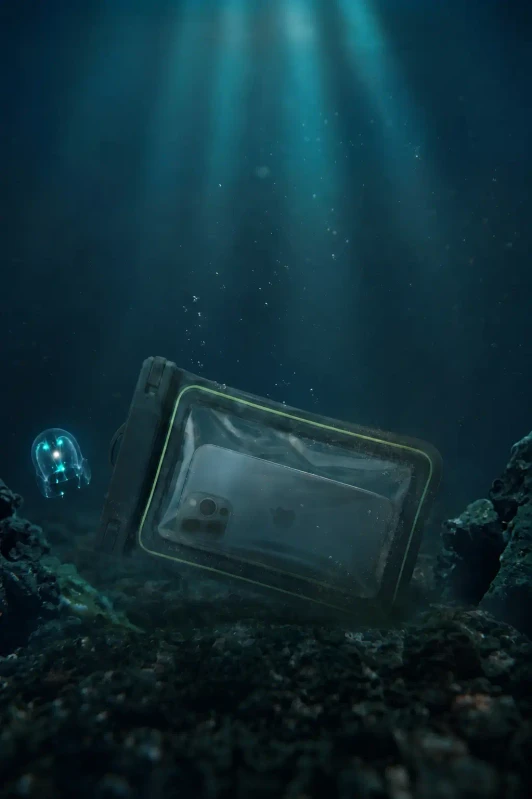
Your phone hits the water. In the next few seconds, a complex series of physical and chemical reactions begin that most people don't consider until they're staring at a black screen.
You're on a boat, a kayak, or leaning over the edge of a dock — and it happens. It isn't just the water itself; it's the environment, the depth, and the chemistry of the liquid that decide whether your device survives.
What Water Resistance Ratings Actually Mean
Most modern smartphones carry an IP67 or IP68 rating. "IP" stands for Ingress Protection. IP67 means the phone can theoretically survive up to 1 meter (about 3 feet) of fresh, still water for 30 minutes. IP68 means it can go slightly deeper or stay submerged longer, depending on the manufacturer's specific testing (usually 1.5 to 6 meters).
These ratings sounds reassuring, but there are massive "fine print" caveats that are critical to understand:
- Still Water Only: IP ratings are tested in a laboratory tank where the water is perfectly still. They do not account for the additional pressure of waves, a rushing river, or the force of your phone hitting the water after a 5-foot drop.
- Fresh Water Only: Saltwater, chlorinated pool water, and even soapy water are not included in the test. These liquids can contain electrolytes or chemicals that bypass seals more easily or cause instant corrosion (especially salt).
- Degradation over Time: A phone that is "water resistant" on day one is not necessarily water resistant on day 365. Every drop on the sidewalk, every scratch on the frame, and even the natural aging of the internal rubber gaskets reduces the integrity of the seal.
The Pressure Trap: Why Depth is the Real Killer
Atmospheric pressure at the surface is around 14.7 psi. As your phone sinks, the water pressure increases by about 0.44 psi for every foot of depth. If you drop your phone in a lake and it sinks to 15 feet, the pressure is nearly double what it was at the surface. This pressure is what forces water past those tiny internal rubber seals surrounding your charging port, speakers, and buttons. This is why depth retrievability is so much more important than simple water resistance. A phone that sinks 30 feet into a lake is under immense stress that no smartphone was designed to handle for more than a few seconds.
The First Seconds: The "Golden Window"
If your phone's seal is reasonably intact, the first few seconds of submersion are the "Golden Window." Modern internal gaskets can usually hold off the liquid for a short duration. The danger begins the moment the device hits the bottom or continues to sink. As the phone descends, the pressure increases and the chance of a "breach" skyrockets.
This is where a flotation device like Floaty completely changes the outcome. If your phone stays on the surface, it remains in the lowest pressure environment possible. It stays retrievable, bobbing in the fresh air instead of sinking into the dark, pressurized depths. The difference between a 3-second retrieval from the surface and a 3-minute search for a sunken device is the difference between a minor inconvenience and a total loss of all your data.
The Case for Buoyancy over "Proofing"
We often think about "waterproofing" as a passive shield. But in the real world of boating and beach trips, you need an active retrieval system. A waterproof pouch is great for keeping the internal electronic dry, but most pouches actually make the phone heavier. That increased weight acts as an anchor. If that dry-pouched phone falls off the side of your boat, it will still sink perfectly protected, forever beyond your reach.
A float accessory doesn't replace the phone's engineering; it works in partnership with it. You trust the manufacturer's gaskets to handle the splashes, and you trust Floaty to handle the physics of the drop. It turns a permanent loss into a quick "scoop and dry" operation.
Survival Checklist: If Your Phone Takes a Dive
- Retrieve it Immediately: Every second counts. If it's floating, grab it. If not, mark your location via GPS instantly.
- Power Down: If the phone is on, turn it off immediately. Electricity and water are a catastrophic mix.
- Rinse with Fresh Water: If it fell in salt water or a murky river, give it a quick, gentle rinse with clean, bottled fresh water to remove corrosives.
- Dry the Exterior: Use a lint-free cloth. Do not use a hairdryer (the heat can melt the seals) or compressed air (which can push water deeper).
- The Charging Port: Never plug in a charger if you suspect water entered the port. Wait at least 24-48 hours or until you see no moisture in the charging area.
Why Floaty is the Essential Insurance
Floaty uses the principle of Displacement. The Floaty is calibrated to displace enough water to keep even the largest modern smartphones afloat. The high-visibility dice stays on the surface, moving with the currents or waves, while your phone hangs safely below it. It doesn't interfere with your camera, it doesn't add weight to your pockets, but it ensures that when "physics happens," it doesn't result in a $1,200 bill.