
The Dry Bag Around Your Neck Isn't Enough
Waterproof phone pouches and floating phone dry bags are the default solution. Here's what it actually feels like to use one — and why most people quietly stop.
Walk into any beach shop, scroll Amazon, or ask anyone heading to the lake what they use to protect their phone near water. The answer is almost always the same: a waterproof phone pouch. A plastic bag with a seal, sometimes a lanyard, sometimes a clip. Brands like JOTO, Pelican Marine, Hiearcool, and CACOE have made this the standard answer to the phone-and-water problem.
It makes sense on paper. Seal your phone in a waterproof pouch or phone dry bag, hang it around your neck, and stop worrying. The problem is the experience of actually doing this for a full day at the beach.
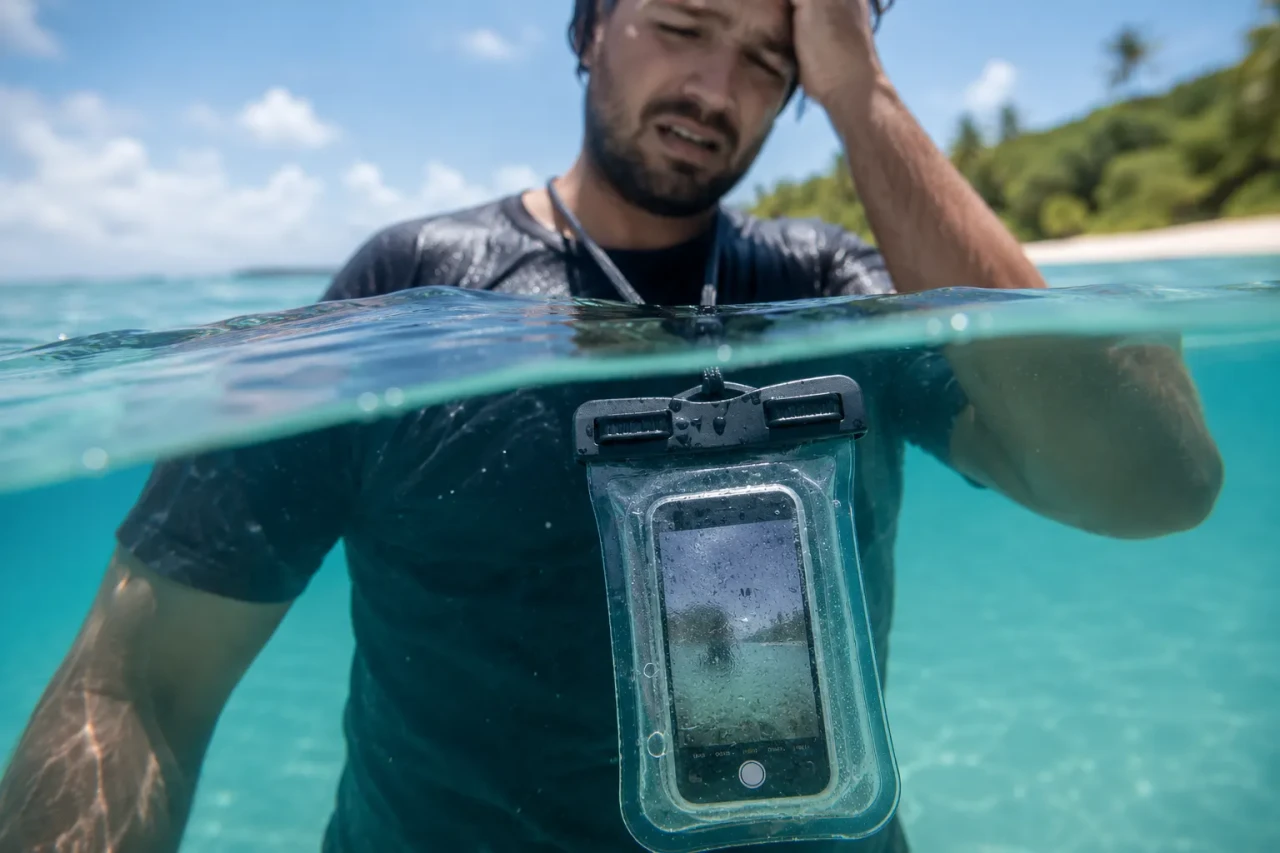
Two Types of Waterproof Phone Pouch
First, it's worth understanding that not all waterproof phone pouches are the same. There are two distinct categories on the market.
The first is a standard waterproof phone pouch or phone dry bag — it seals your phone in waterproof plastic, usually rated IPX8, but it sinks if dropped. If you're swimming and your phone slips out of your hands, you're diving after it or hoping it didn't go deep. These are the $8-$15 pouches you find everywhere. They keep water out. What happens after a drop is your problem.
The second type — brands like Pelican Marine, CACOE, and others in the "floating waterproof phone pouch" category — adds foam or trapped air to make the entire case float. If you drop it overboard, it comes back to the surface. These run $25-$50 and are a genuine improvement over the basic version. The floating waterproof phone case with lanyard has become the go-to for kayakers and boaters who want retrieval built in.
Both solve part of the problem. Both share the same compromises. Here's what those compromises actually feel like.
The Touchscreen Problem
Every waterproof phone pouch uses a transparent TPU or PVC window over the screen. Manufacturers describe this as "touchscreen compatible" or "touch sensitive." And technically, it is — in the same way that typing with rubber gloves is technically compatible with a keyboard.
In practice, the touch experience through the plastic membrane is noticeably degraded. Taps don't always register on the first press. Scrolling feels sluggish and slightly resistive. Swiping between apps has a drag that isn't there on a bare screen. Multi-touch gestures — pinch-to-zoom, two-finger scroll — become unreliable. Independent reviews confirm this consistently: "touch sensitivity isn't perfect for all screen actions," "touch can be slightly reduced," "not ideal for complex interactions."
It's a little like using a phone from five years ago — functionally possible, never quite right. You find yourself pressing harder. Tapping twice when once should have worked. The friction is small but it's constant, and after a few hours it wears on you.
What Happens to Your Photos
The camera window is where the waterproof phone pouch fails most visibly. There's a layer of plastic between your lens and the world — and no matter what the manufacturer says about optical clarity, physics doesn't negotiate.
TPU fogs. On warm beach days, the temperature difference between cool water and warm air creates condensation on the inside of the pouch. You don't notice it until you look at your shots. The images you thought were capturing the moment are soft, hazy, slightly flat. Multiple reviewers report the same: "easy to fog up, photos are not clear." Even without fogging, shooting through plastic changes how light enters your lens. Colors flatten. Contrast drops. The shots look fine at a glance and subtly wrong at full size.
For a beach trip, a lake day, a kayak run — you're there partly to document it. The photos matter. A waterproof phone case or pouch that compromises your camera compromises one of the main reasons you brought your phone.
The Lanyard Around Your Neck
The waterproof phone pouch with lanyard hangs around your neck. A modern iPhone 15 Pro Max weighs 221 grams. Add the pouch and you have roughly 270 grams — more than half a pound — swinging from a thin cord against your chest.
Reviewers across brands are honest about this: "the cord digs into your neck or feels uncomfortable, particularly with heavier phones during longer use." After an hour in the water, the lanyard has migrated. It's rubbing your neck. The pouch is swinging when you swim, floating up into your face when you dive under, bouncing against your chest when you move quickly. You're constantly adjusting it, grabbing it, relocating it.
And every time you want to check your phone, you reach up, grab the pouch, hold it still, squint through the plastic, do what you need to do, and lower it back down. It's a solution that keeps reminding you it's there.
The Seal Ritual
Waterproof phone pouches and phone dry bags rely on a seal — a zipper, a roll-top, a snap-lock. Every single time you put your phone in, you have to verify the seal is complete. No sand grain caught in the track. No hair in the zipper. No slight misalignment.
One failure and the thing the pouch was supposed to prevent happens anyway. IPX8 certification means it passed a lab test. It doesn't account for the sand you didn't notice, the zipper that's been opened and closed 40 times this summer, or the seal you checked but didn't fully close.
Most pouches also require you to remove your phone's existing case before sealing it — the case doesn't fit, or it breaks the seal. So before every swim: remove case, seal phone in pouch, check seal. After every swim: open pouch, dry phone, replace case. The ritual repeats every time you go in and out of the water.
The Honest Summary
The waterproof phone pouch — and its upgraded sibling, the floating waterproof phone pouch — solves the right problem with the wrong approach. It protects your phone from water by making the phone significantly worse to use. The touchscreen is degraded. The camera is compromised. The physical experience is uncomfortable. The ritual of sealing and unsealing adds friction to every swim.
The floating version adds real value — retrieval without diving. But it's a better version of a fundamentally limited approach.
A Different Question
Floaty starts from a different premise entirely. Instead of "how do we seal the phone away from water," the question was: "what if the phone didn't need to be sealed away at all?"
The Floating Dice connects to your phone magnetically via MagSafe. Near water, the Floating Dice is there — tethered, floating above the surface as a visible marker. If your phone goes in, you spot the Floating Dice, reach down, retrieve your phone in seconds. Your camera stays unobstructed. Your touchscreen is your touchscreen. Your case stays on. MagSafe charging still works. There's no lanyard digging into your neck, no seal to check, no plastic between you and your phone.
The experience of being near water doesn't change. You just stop being afraid of the drop.
Beyond the grip.
Be first when Floaty launches.
Join the waitlist for priority pricing and early access.
Join the Waitlist