
The Hidden Cost of a Waterproof Phone Case
OtterBox, LifeProof, Ghostek. Rugged waterproof cases promise total protection. Here's what they don't put on the box.
The waterproof phone case is the grown-up solution. Not a plastic bag. Not a pouch on a lanyard. A real, model-specific, precision-engineered case that seals your phone from every angle — water, dust, drop, shock. Brands like OtterBox Fre Series, LifeProof FRĒ, and Ghostek Nautical have spent years building these products, and they sell millions of them.
If you spend serious time near water and want maximum protection, a rugged waterproof phone case is a reasonable choice. But the trade-offs are real, they're daily, and they never fully go away. Here's what the marketing doesn't highlight.
The Bulk You Live With Every Day
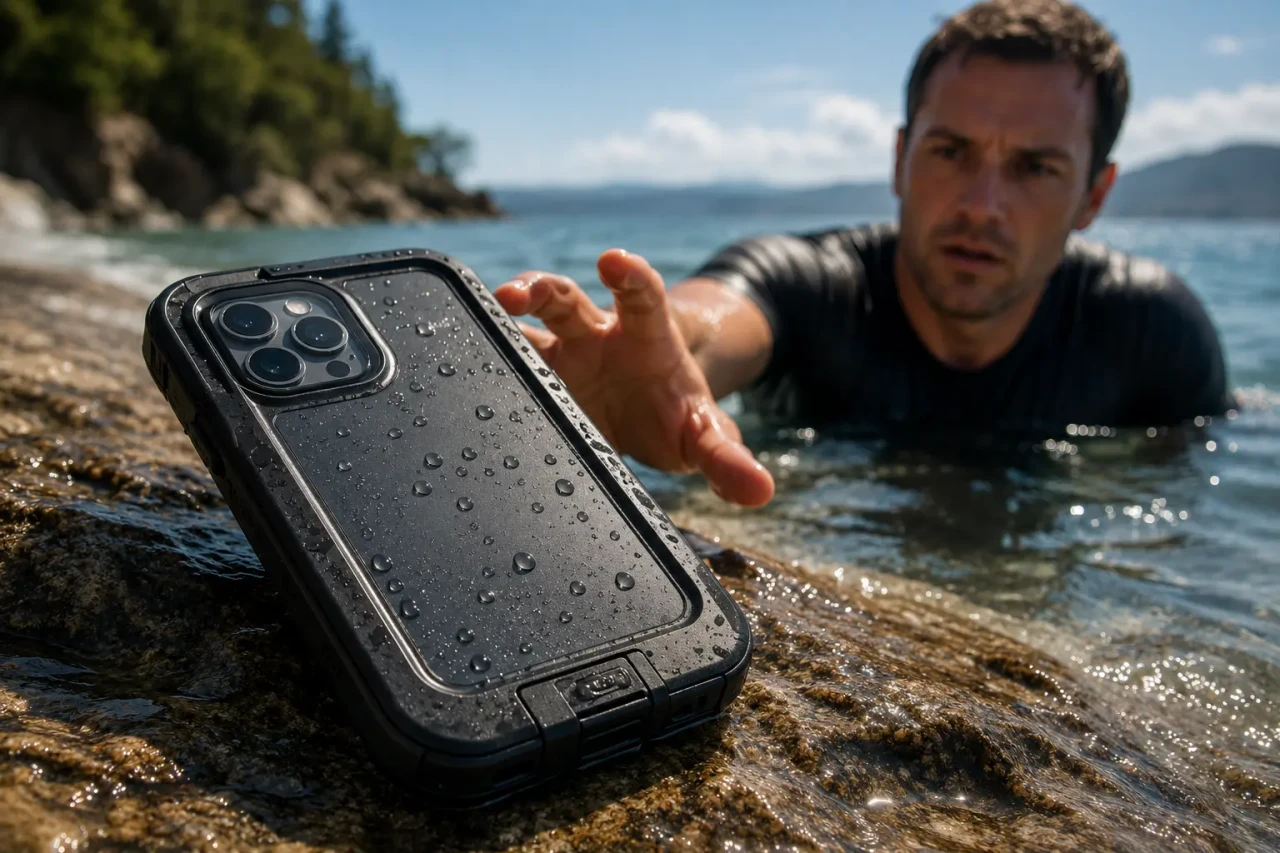
Waterproof phone cases are thicker than standard cases. Not dramatically — but noticeably. The sealed port covers, the reinforced frame, the built-in screen protector — each adds millimeters. An iPhone 15 Pro that fits precisely in your hand suddenly feels like a different device. Pockets are tighter. Wireless chargers need repositioning. The case dominates the aesthetic of a phone that was designed to look a certain way.
OtterBox's own guide acknowledges this: "Perceived bulkiness: Better protection requires a little more space." At $99 for a model like the Fre Series, you're paying a premium price for daily bulk that affects how your phone feels in your hand every single day of the year — not just the days you're near water.
The Touchscreen That Works Differently
Every rugged waterproof case uses a built-in screen protector to seal the front of the phone. This creates a physical barrier between your fingertips and the actual glass. The result is a touch experience that's close to normal — but not identical.
Reviewers are consistent: "Typing requires slightly more pressure." "Lower-quality models may affect screen sensitivity." The AppleInsider review of the OtterBox Fre Series was direct: "Manipulating the touchscreen underwater just isn't possible." And even above water, the feel is subtly different — taps require slightly more deliberate contact, gesture recognition is occasionally inconsistent, Face ID and fingerprint sensors may need more alignment.
It's not dramatic. But it's there. Every time. And when you're trying to capture a quick video of the moment before it passes, that slight additional friction matters.
What Happens to Your Camera
The camera is where the waterproof case makes its most visible compromise. There's a clear polycarbonate or glass lens cover built into the case, sitting in front of your camera array. It's optically clearer than a plastic pouch — but it's still an additional layer.
In practice this means: photos taken through a waterproof case are close to normal. Not identical. There's a fractional loss of contrast and sharpness that you may not notice until you compare a direct shot and a cased shot side by side. In bright sunlight at the beach — where your camera is already working hard — any additional layer between the lens and the subject compounds. The photos are good. They could have been better.
More importantly: the case seals your camera ports, which can muffle the microphone during video. Speaker grilles are similarly affected — the case has to maintain a seal, which means sound has to pass through sealed membranes rather than open ports.
The Charging Problem
To maintain a waterproof seal, every charging port has to be covered. That means a port cover — usually a small flap or plug — that you have to open to charge your phone, and close again afterward. Every night. Every time your battery is low. For two or three days at the beach, this is fine. As an everyday case, it's a ritual that compounds over 365 days.
Some waterproof cases — like the OtterBox Fre — maintain MagSafe compatibility, which eliminates the port cover issue for wireless charging. But many models block or reduce MagSafe efficiency, and some are incompatible entirely. If you've built a workflow around MagSafe mounts, wallets, or chargers, a waterproof case may require you to change it.
The Phone Upgrade Problem
Waterproof phone cases are model-specific. The OtterBox Fre for iPhone 15 Pro does not fit an iPhone 16 Pro. When you upgrade your phone — which most people do every one to two years — the case becomes useless. At $79-$120 per case, that's a recurring cost that resets every upgrade cycle.
It's worth acknowledging that this is a trade-off most people consciously accept when they buy a premium protective case. But it's worth naming, especially when you're spending close to $100 for something that has a built-in expiration date.
What Waterproof Cases Don't Solve
Here's the thing that most people don't realize until they're standing at the edge of a boat or a kayak with a waterproof case on their phone: the case doesn't float.
Most rugged waterproof phone cases — OtterBox Fre, LifeProof FRĒ, Ghostek Nautical — are not buoyant. If your sealed, waterproof, $100 phone drops into deep water, it sinks. The phone stays dry inside, but it sinks. You're diving for it, or watching it descend.
The waterproof case solves the water damage problem. It doesn't solve the retrieval problem. And on a boat, a dock, or a kayak — the retrieval problem is often the more important one.
Who Waterproof Cases Are Actually For
Rugged waterproof cases make genuine sense for specific people: construction workers, hikers in wet environments, people who work outdoors year-round, anyone who needs drop protection and water resistance integrated into a single everyday case. If water exposure is a daily occupational reality rather than a summer activity, the trade-offs of a waterproof case are worth accepting.
For the beach trip, the kayak weekend, the boat day — the waterproof case is often overkill in one dimension (daily bulk, daily friction) and not quite enough in another (buoyancy, retrieval).
A Different Answer
Floaty doesn't try to replace your case. It works with whatever case you already have — snapping magnetically to your phone via MagSafe over your existing setup. Near water, the Floating Dice connects and stays visible above the surface as a retrieval marker. If your phone goes in, you spot it instantly and retrieve it in seconds.
The rest of the time — every day that isn't a water day — your phone is your phone. No added bulk. No built-in screen protector. No port covers. No compromise to your camera. Full MagSafe functionality. The same touch experience you've always had.
Floaty is for the days you're near water. Not a permanent change to the device you use every day.
Beyond the grip.
Be first when Floaty launches.
Join the waitlist for priority pricing and early access.
Join the Waitlist